Category: Uncategorized

School Rugby Rankings [Date: 26/04/2026]

Season Ranking — 2026

# Team Win% Points +/- ±Pts
1 Paarl Gimnasium 92.86 75.30 +0.87
2 Garsfontein 78.57 69.00 0.00
3 Paul Roos Gimnasium 84.62 67.05 ▲ 1 +0.73
4 Stellenberg High School 86.67 67.04 ▼ 1 +0.62
5 Afrikaanse Hoër Seunskool 64.29 66.96 ▲ 1 +2.34
6 Zwartkop 81.25 66.66 ▲ 1 +2.27
7 Paarl Boys High 66.67 66.42 ▼ 2 +0.61
8 Hoërskool Waterkloof 78.57 63.98 +0.59
9 Wynberg Boys' High School 66.67 63.60 ▲ 2 +1.57
10 Grey College 72.73 62.97 ▼ 1 0.00
11 Michaelhouse 61.54 62.69 ▼ 1 0.00
12 Pietersburg Hoërskool 80.00 62.37 +0.76
13 Drostdy 80.00 62.23 ▲ 5 +1.79
14 Hoërskool Monument 66.67 61.77 ▲ 1 +0.94
15 Hilton College 81.82 61.35 ▼ 2 0.00
16 Graeme College 88.89 60.91 ▼ 2 0.00
17 Grey High School 81.82 60.34 ▲ 4 +1.33
18 Westville Boys' High School 57.14 59.62 ▲ 2 0.00
19 Hoerskool Jim Fouche 85.71 59.23 ▲ 8 +1.32
20 Hoërskool Kempton Park 62.50 58.85 ▲ 8 +1.01
21 Maritzburg College 60.00 58.41 ▼ 4 -2.34
22 Hoërskool Transvalia 50.00 58.23 ▲ 13 +3.03
23 Rondebosch Boys High School 64.29 58.08 ▼ 1 -0.86
24 Parel Vallei High School 87.50 58.07 ▲ 1 0.00
25 Welkom Gimnasium 55.56 58.00 ▲ 1 0.00
26 Northwood School 57.14 57.87 ▲ 3 +0.82
27 Durban High School 60.00 57.87 ▼ 3 -0.71
28 Hoërskool Noordheuwel 43.75 57.85 ▼ 12 -2.97
29 Hoërskool Nelspruit 71.43 57.81 ▼ 10 -2.27
30 Hoer Landbouschool Oakdale 40.00 56.81 ▼ 7 -1.79
31 Trio High School 45.45 56.70 ▲ 5 +1.69
32 Dale College 81.82 56.60 ▼ 2 0.00
33 Hoërskool Menlopark 57.14 56.05 ▲ 21 +4.47
34 Ben Vorster 70.00 55.81 ▼ 2 0.00
35 Hoerskool Diamantveld 54.55 55.81 ▲ 3 +1.24
36 Kingswood College 75.00 55.80 ▼ 3 0.00
37 Hoërskool Oos-Moot 53.85 54.45 ▲ 18 +3.69
38 Hudson Park High School 46.15 53.92 ▲ 11 +1.71
39 Charlie Hofmeyr 100.00 53.90 0.00
40 Heidelberg 62.50 53.46 ▲ 8 +1.22
41 Helpmekaar 50.00 53.35 ▼ 10 -2.98
42 Wesvalia 53.85 53.14 ▼ 1 0.00
43 Jeppe High School For Boys 42.86 52.86 ▲ 7 +0.71
44 SACS 42.86 52.53 ▼ 4 -0.73
45 Nico Malan High School 50.00 52.50 0.00
46 Kearsney College 53.85 52.45 0.00
47 HTS Middelburg 64.29 52.37 ▼ 10 -2.47
48 Montana 45.45 52.35 ▼ 14 -3.03
49 King Edward VII School 50.00 52.08 ▲ 18 +3.73
50 Hoërskool Hugenote 57.14 52.05 ▲ 1 0.00
51 Framesby 53.85 51.64 ▼ 8 -1.33
52 Boland Landbou 30.77 51.44 ▼ 10 -1.56
53 Hoërskool Rustenburg 35.71 51.43 ▲ 20 +4.47
54 Witteberg Hoerskool 45.45 51.31 ▲ 16 +3.41
55 Hoërskool Outeniqua 54.55 51.13 ▼ 2 -0.62
56 Hoërskool Piet Retief 55.56 51.03 ▲ 2 +0.77
57 Hoerskool Sentraal 50.00 50.60 ▼ 10 -1.69
58 Marais Viljoen 41.67 50.47 ▲ 23 +5.63
59 Bethlehem Voortrekker Hoerskool 33.33 50.44 ▼ 7 -1.33
60 St John’s College 62.50 50.36 ▼ 4 0.00
61 Pretoria Boys High School 45.45 50.18 ▼ 17 -2.49
62 Daniel Pienaar 40.00 49.94 ▼ 3 0.00
63 Die Anker 42.86 49.82 ▼ 3 0.00
64 Queen's College 33.33 49.79 ▼ 3 0.00
65 Bergsig 57.14 49.67 ▼ 2 0.00
66 Hoërskool Ermelo 66.67 49.47 ▼ 2 0.00
67 Bellville High School 44.44 48.97 ▲ 4 +1.31
68 Pearson High School 57.14 48.51 ▼ 2 0.00
69 Hoër Volkskool Potchefstroom 33.33 48.15 0.00
70 Hoërskool Fichardtpark 54.55 48.01 ▼ 13 -2.27
71 Selborne College 36.36 47.97 ▼ 9 -1.70
72 EG Jansen 29.41 47.58 ▼ 4 -0.59
73 Merensky Landbou Akademie 40.00 47.04 ▼ 1 0.00
74 Potchefstroom Gimnasium 33.33 46.80 ▲ 1 0.00
75 Hoerskool Durbanville 38.46 46.24 ▼ 1 -0.61
76 Bishops 25.00 45.76 ▲ 1 0.00
77 Ligbron 44.44 45.54 ▼ 12 -3.75
78 St Charles College 28.57 45.36 0.00
79 Middelburg High School 23.08 45.27 ▼ 3 -0.94
80 Swartland High School 50.00 44.94 ▼ 1 0.00
81 Brackenfell High School 20.00 44.18 ▲ 2 0.00
82 Hoër Landbouskool Marlow 33.33 44.09 ▲ 2 0.00
83 Lichtenburg 20.00 44.07 ▼ 1 -0.76
84 Parktown Boys High School 33.33 43.69 ▲ 2 0.00
85 DF Malan 0.00 43.68 ▲ 2 0.00
86 Dinamika 33.33 43.57 ▲ 2 0.00
87 Milnerton High School 11.11 42.97 ▲ 15 +3.98
88 Klerksdorp Hoërskool 22.22 42.94 ▼ 3 -1.01
89 Hoërskool Randburg 0.00 42.85 ▲ 1 0.00
90 Hoërskool Brandwag 16.67 42.49 ▲ 2 0.00
91 Worcester Gymnasium 14.29 42.49 0.00
92 St Stithians College 25.00 42.48 ▲ 1 0.00
93 Jeugland 16.67 42.26 ▲ 1 0.00
94 Tygerberg High School 12.50 42.22 ▼ 14 -2.65
95 Goudveld Hoërskool 14.29 41.65 ▼ 6 -1.24
96 Strand High School 20.00 41.42 0.00
97 Glenwood High School 9.09 40.32 -0.83
98 Hermanus High School 0.00 40.15 ▼ 3 -1.32
99 St Alban’s College 12.50 39.92 0.00
100 Muir College 0.00 39.31 0.00
101 St Andrew's College 7.69 39.18 0.00
102 Secunda 14.29 39.15 ▼ 4 -1.21
103 St Benedict’s College 0.00 35.43 0.00
104 Hoërskool Eldoraigne 0.00 32.88 -0.78

Get Involved: Your Place in the Rugby Ignite Record

Rugby Ignite is South Africa’s online record of school rugby fixtures and results. Every match tracked. Every season preserved. The complete picture of school rugby, built by the people closest to the game.

That last part matters. The record is only as complete as the people who contribute to it. Whether you coach a team, play for one, or simply follow the game, there is a place for you on Rugby Ignite.


Three Ways to Be Part of This


Fan

You don’t need to be involved in a school to care about school rugby. Fans are the heartbeat of the game, the supporters on the touchline, the ones who follow fixtures across provinces, the people who’ve watched the same schools battle for decades.

Register as a fan and you can search the full fixture record by school, province, season or festival, follow schools you care about, and join the conversation with comments. No data entry required. Just the game, fully accessible.


Coach

You know the results before anyone else does. You live the season from the first training session to the final fixture.

Coaches on Rugby Ignite are the people who keep the record honest. Submit results, manage your fixture list, update your squad, and post updates for your school’s supporters. One trusted person per team, the person closest to the game, keeping the data accurate.

If you coach or manage a school team, this is your role.


Player

The record exists because of you.

Register as a player, build your profile, and link yourself to your team. Your career record, every season, every team you’ve represented, is kept honestly and permanently on Rugby Ignite. As the platform grows, your record grows with it.


Why Register?

The Rugby Ignite record doesn’t build itself. Every result, every fixture, every season on this platform was submitted by someone who cares about school rugby.

When you register, you’re not just creating an account. You’re becoming part of a permanent record of South African school rugby, one that coaches, players, and supporters will reference for years to come.

The data belongs to the game. Help us keep it honestly.


Register Now

Creating an account takes 60 seconds.

Register on Rugby Ignite — rugbyignite.co.za

Ignite the passion. Honour the game.

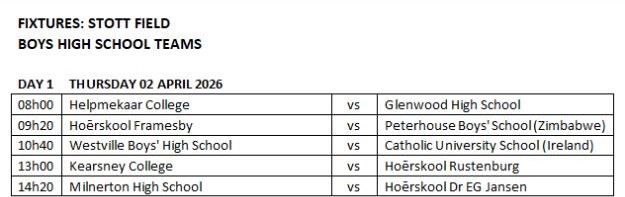
Kearsney Easter Rugby Festival 2026 Fixtures Announced

The Kearsney Easter Rugby Festival (KERF) returns once again as one of South Africa’s premier schoolboy rugby gatherings, bringing together leading local teams alongside international visitors for a celebration of the game that blends tradition, development and high-quality competition.

Over the years, Kearsney Easter Rugby Festival has earned a reputation for producing entertaining rugby and memorable matchups, while providing a platform where established rugby schools and rising programmes can test themselves against diverse playing styles. This year’s festival features 28 teams, including touring sides from Ireland, Italy and Zimbabwe, adding an exciting international flavour to the Easter weekend spectacle.

At the heart of the festival remains a strong South African presence, with schools from across the country representing the depth of local school rugby. KwaZulu-Natal is well represented by Durban High School (DHS), Westville Boys’ High, Glenwood High School and hosts Kearsney College — programmes steeped in tradition and known for producing competitive, structured rugby.

They are joined by strong travelling sides including EG Jansen and Helpmekaar from Gauteng, Hoërskool Rustenburg from the North West, Hoërskool Framesby from the Eastern Cape, and Milnerton High School from the Western Cape. Each brings its own identity and rugby culture, creating a balanced festival lineup that reflects the diversity of South African school rugby.

Played across three days over the Easter weekend, the festival is known for its fast-paced fixtures and attacking style of rugby, often producing matchups that shape early-season narratives and introduce emerging talent to a wider audience. The inclusion of international touring teams adds another layer of intrigue, offering local supporters a rare opportunity to witness different rugby philosophies on South African soil.

Beyond the main fixtures, Kearsney Easter Rugby Festival continues to expand its role in developing the game through additional youth participation, including girls’ rugby matches and primary school fixtures that contribute to the festival’s inclusive, community-driven atmosphere.

Set on the picturesque Kearsney College campus, the event combines competitive rugby with a family-friendly festival environment, attracting players, supporters and rugby enthusiasts who return year after year for one of the highlights of the school rugby calendar.

Paarl Boys vs Paarl Gim — When a Town Becomes a Stadium

There are big schoolboy rugby matches in South Africa, and then there is the Paarl derby.

When Paarl Boys’ High meets Paarl Gimnasium, rugby stops being just a sport. For one afternoon, the entire town seems to move toward a single destination, pulled by a rivalry that feels as old as the mountains surrounding it.

This is not a quiet fixture. It doesn’t build slowly. It arrives with noise, colour, and an energy that feels impossible to ignore.

A Rivalry That Belongs to the Town

Unlike many school derbies that live primarily within their own communities, the Paarl derby spills out into the streets. Shops talk about it. Families plan around it. Generations of supporters treat it as a yearly marker — something you don’t miss unless you absolutely have to.

Paarl Boys’ High and Paarl Gimnasium carry distinct identities that reflect deeper cultural roots within the town. The rivalry isn’t just about rugby results; it carries language, tradition, and pride that stretch beyond the field.

And yet, despite its intensity, there’s an underlying respect that keeps the rivalry grounded. Both schools understand what this match represents — not only to themselves, but to South African school rugby as a whole.

Arriving Early — Because You Have To

If you arrive late, you’ve already missed part of the experience.

Crowds gather hours before kickoff. Supporters dressed in school colours begin to fill the stands long before the teams appear. The noise starts early — singing, chanting, groups finding their rhythm and testing their voices.

There’s very little of the quiet anticipation found at other iconic fixtures. Instead, the atmosphere feels alive from the moment you step onto the grounds.

Students move in coordinated groups, organised but spontaneous at the same time. Old boys arrive with stories ready, recounting past derbies as if they happened yesterday. Younger players watch from the sidelines, absorbing every detail, already imagining what it might feel like to one day run onto the field themselves.

When the Noise Takes Over

Kickoff doesn’t start the atmosphere — it releases it.

The sound becomes constant. Songs rise and fall, sometimes competing with each other across the field. Big moments trigger waves of reaction that ripple through the crowd instantly, as if thousands of people are connected by the same pulse.

It feels closer to a festival than a school match.

Every tackle is met with noise. Every break in play carries anticipation because the crowd never truly switches off. Even neutral spectators often find themselves drawn into the energy, cheering almost without realising it.

What makes the Paarl derby unique is the way the supporters shape the game itself. The players feed off the atmosphere, and the crowd responds to every shift in momentum. It becomes a conversation between field and stands, each influencing the other.

More Than Just Rugby

The Paarl derby isn’t defined only by what happens between the white lines.

It’s about belonging — to a school, to a tradition, to a town that has embraced this rivalry as part of its identity. The shared history between the two schools means every match carries layers of meaning, and every result becomes part of a story that continues to grow.

You don’t need to be an old boy to feel it. Standing among the crowd, you quickly understand that this is one of the most supported and emotionally charged environments in schoolboy rugby anywhere in the country.

Afterwards

When the final whistle blows, the energy doesn’t disappear immediately.

Groups linger, voices slightly hoarse from hours of singing and shouting. Conversations replay key moments, debates continue, and the town slowly returns to normal — until the next year, when everything builds again.

Because Paarl Boys vs Paarl Gim isn’t just another derby.

It’s a day when rugby takes over an entire town — and everyone knows exactly where they’re supposed to be.

Grey College vs Grey High — When Two Greys Collide

Some rivalries grow out of geography. Others out of history.

Grey College versus Grey High carries both — and something else that’s harder to define but impossible to ignore once you experience it.

This isn’t just a schoolboy rugby match. It feels like a confrontation between two traditions that share a name but have built their own identities over decades of competition.

And when they meet, the atmosphere reflects that.

A Rivalry Written Into South African Rugby

Grey College in Bloemfontein has built a reputation that stretches far beyond schoolboy rugby. Known as one of South Africa’s most dominant rugby institutions, its history is layered with provincial players, Springboks, and generations of teams who carry an expectation of excellence every time they step onto the field.

Grey High School in Gqeberha brings a different energy — equally proud, fiercely competitive, and deeply rooted in its own rugby culture. Where Grey College carries an aura of dominance, Grey High brings a sense of challenge, a refusal to be overshadowed despite the weight of history on the other side.

When these two meet, the shared name becomes part of the narrative. It’s not just Grey vs an opponent — it’s Grey vs Grey. Similar colours, different traditions, one result.

Arriving at the Ground

The build-up feels different from many other school fixtures. There’s an intensity even before kickoff, a sense that this is more than another stop on the season’s schedule.

Supporters arrive early, and conversations often start with history — past results, legendary matches, unforgettable moments that have shaped how each side views the other. Old boys gather with an almost protective pride, aware that this fixture represents more than just the current team.

Unlike the quiet tension of Midlands derbies, this atmosphere builds faster. You feel it in the crowd’s energy, in the way supporters react to warm-up drills, in the subtle rivalry between groups standing along opposite touchlines.

There’s anticipation, but also an edge.

The Matchday Energy

When kickoff arrives, the tone shifts immediately.

The crowd engages with every collision. Big tackles draw instant reactions. Momentum swings are felt not just by the players but by everyone watching, as if the entire ground is invested in every metre gained or lost.

There is something uniquely South African about the way schoolboy rugby is supported at fixtures like this. Families, students, old boys, and neutral spectators all merge into a single atmosphere that feels intense without losing its sense of tradition.

The shared name adds a strange dynamic. Moments of brilliance from either side are met with admiration and frustration in equal measure, as if supporters recognise the rugby culture reflected back at them from across the field.

More Than Reputation

Grey College’s dominance in South African school rugby means they often enter the fixture carrying expectation. But rivalry matches rarely follow expectation.

Grey High’s role in this encounter is never simply to participate — it’s to challenge, disrupt, and remind everyone that history doesn’t guarantee results.

That tension shapes the way the game unfolds.

Every breakdown feels contested. Every scoring opportunity carries a little more weight. Players seem aware that they are representing more than themselves — they are defending a legacy attached to a name shared by both teams.

After the Final Whistle

When the match ends, the conversations begin immediately.

Supporters debate moments as if they have already become part of the rivalry’s history. Old boys revisit past matches, comparing eras and performances, reinforcing the idea that this fixture is less a single event and more a continuing story.

Because Grey College vs Grey High isn’t just about determining which team wins on the day.

It’s about identity.

Two schools connected by name, separated by geography, and bound together by a rivalry that continues to define what schoolboy rugby in South Africa can feel like at its most intense.

Hilton vs Michaelhouse — Where Tradition Meets Thunder

Some schoolboy rugby matches are loud from the start — drums, shouting, constant noise. Hilton vs Michaelhouse isn’t like that.

The first thing you notice is how quiet it feels.

Not empty quiet, but a kind of heavy stillness that settles over the grounds long before kickoff. Cars arrive steadily along the narrow Midlands roads, old boys greet each other like they were here just last weekend instead of last year, and players move through their warm-ups with a focus that feels different to a normal fixture. There’s an awareness that this is not just another Saturday.

The venue itself plays a role in shaping the day. Whether it’s hosted at Hilton or Michaelhouse, the setting feels slightly removed from everything else — rolling hills, wide open skies, and fields that seem to carry decades of memories without needing to announce it. You don’t walk into chaos; you walk into something that already feels established.

Supporters don’t rush. They settle in.

Parents claim familiar patches of grass. Younger boys hover along the ropes, watching the first team players with a mixture of admiration and nervous energy. Old boys stand just far enough back to take it all in, often speaking more about past encounters than the current one — reminding anyone within earshot that this fixture has always mattered.

As kickoff approaches, conversations fade. The crowd doesn’t erupt; it tightens. There’s a collective shift in attention that is hard to explain until you experience it. You feel it in the way people stop moving, the way heads turn in unison when the teams run out.

When the game starts, the atmosphere builds gradually rather than exploding. Every carry and tackle seems to land heavier. Applause isn’t constant — it comes in waves, rising and falling with the momentum of the match. You become aware of how closely everyone is watching, how every decision from the referee draws a murmur that travels across the field like wind through grass.

This is one of the best supported schoolboy rugby fixtures in the country, but it doesn’t rely on theatrics. The energy feels rooted in tradition rather than spectacle.

Halftime brings one of those moments that you don’t fully appreciate until you’re standing in the middle of it. As the “Old Boys of Hilton” begins, the atmosphere changes again. Conversations stop almost instinctively. Voices join together, not perfectly polished but full and sincere, carrying across the field in a way that makes the hair on your arms stand up before you realise why.

People often compare it to Kearsney’s famous rendition of Shosholoza, and the comparison makes sense — both moments capture something deeply emotional about schoolboy sport — but the Hilton tradition has its own character. It feels less like a performance and more like a shared memory being replayed year after year.

When the second half starts, the intensity shifts again. The crowd leans forward more. The tackles feel sharper, the reactions louder. Every phase carries the weight of the rivalry, because this match is about more than a result on a fixture list.

In the Midlands, Hilton vs Michaelhouse is about bragging rights that last long after the final whistle. It shapes conversations in boarding houses and staffrooms, at braais and reunions, and in the quiet pride or frustration carried by supporters long after the teams leave the field.

Other KZN rivalries have their own stories, and some bring more noise or larger crowds, but none quite replicate this particular atmosphere. Even the long-standing Glenwood clashes don’t carry the same Midlands identity — that blend of tradition, rivalry, and respect that feels almost understated until you realise how deeply it runs.

When the game ends, people don’t rush away immediately. Groups linger, replaying moments, debating decisions, reconnecting with friends they may only see once a year. The grounds slowly return to that same stillness that existed before kickoff, as if the day folds back into itself and waits patiently for next season.

And that’s perhaps what makes Hilton vs Michaelhouse special. It doesn’t need to declare itself as iconic. It simply continues, year after year, supported by those who understand what it means to be there.

Build Your Rugby Future with Rugby Ignite Player Profiles

In the modern game, it’s not just what you do on the field — it’s how you track it. Whether you’re chasing a provincial call-up, a varsity scholarship, or a professional contract one day, having a clear, detailed record of your performances matters.

That’s where Rugby Ignite Player Profiles come in.


Your Rugby CV, In Your Hands

Every player now has the opportunity to create their own online profile on Rugby Ignite — a digital rugby CV where you can record, track, and showcase your performances across every season.

Whether you’re in Grade 8 or playing 1st XV, you can keep a personal record of:

  • Games played
  • Minutes played
  • Points scored
  • Tries
  • Conversions
  • Penalties
  • Drop goals
  • Cards received
  • Player of the Match awards

It’s your personal record of your rugby journey — the highs, the challenges, and the milestones.


Why It Matters

When scouts, selectors, and coaches look for players, they’re not just looking at one good game — they want consistency, numbers, and character over time.

A Rugby Ignite profile lets you show exactly that. It helps you track your growth, reflect on areas to improve, and present a professional, organized snapshot of your rugby career so far.

As the saying goes: “Hard work leaves evidence.” This is yours.


Start Early, Track Everything

The earlier you start, the better. Keep track of your games from U14 level if you can. Every appearance, every minute, every point counts. It tells a story about your commitment and progression as a player.


How to Set Yours Up

It’s simple:

  1. Register on the Rugby Ignite platform
  2. Create your personal player profile
  3. Add your stats after each game
  4. Update your records every season
  5. Track your improvement, set goals, and build your rugby résumé

Own Your Journey

In rugby — like in life — no one will hand you your future. You’ve got to work for it, track it, and chase it. Rugby Ignite’s Player Profile is a tool to help you do just that.

Your career. Your numbers. Your legacy. Build it.

How the Rugby Ignite School Rugby Ranking Works.

Rugby Ignite is South Africa’s online record of school rugby fixtures and results. Every fixture tracked. Every result recorded. The complete, honest picture of school rugby across every province.

Part of that record is a ranking — and here is exactly how it works.


Why Win Percentage?

Rankings can get complicated quickly. Bonus points, strength of opposition, margins of victory — systems that try to account for everything often end up being understood by no one.

Win percentage keeps it simple without sacrificing accuracy.

Win Percentage = (Games Won ÷ Games Played) × 100

If your school plays 10 matches in a season and wins 7, your win percentage for that season is 70%. Any coach, supporter, or player can read that number and know exactly what it means.

But simplicity isn’t the only reason. Win percentage is also the fairest way to compare schools across different fixture schedules. Whether your school plays 8 games a season or 16, the metric is consistent. It’s the same number a coach reads every Monday morning — not a judgement, just what the results say.


A Record Built Over Time

One good season doesn’t define a rugby programme. Neither does one difficult one.

That’s the point of tracking win percentage across multiple seasons. A school can’t have one strong run and dramatically shift its ranking. Consistency is what the record rewards — the programmes that perform season after season, rebuild when they need to, and keep showing up.

Rugby Ignite gives schools and supporters the ability to see that full picture:

  • Each season’s win percentage
  • A rolling average across multiple seasons
  • How the record shifts over time

It’s the difference between a snapshot and a story. The data tells both.


What About Fixture Strength?

It’s a fair question — and an honest one.

In schoolboy rugby, most schools face the same opposition year after year. Festivals add variety, but fixture lists are largely set. The top rugby schools play other top-tier sides every week. Schools where the game is still growing face similar opposition. That is simply how the game is structured.

Win percentage doesn’t try to correct for that — and that’s a deliberate choice. Every school is judged on its own record, in the games it plays. Good seasons and difficult ones happen to every programme. The metric reflects that honestly.

The rankings are also broken down province by province, so schools are compared directly with their local rivals — the teams they see on the touchline every season, the sides they’ve built histories with.


Finding the Record

The ranking is one part of what Rugby Ignite tracks. The full record is searchable by school, province, season, and festival — so whether you’re following a specific school across the years or looking at how a province’s fixtures played out in a given season, the data is there.

Every result recorded. Every fixture tracked.


Ignite the passion. Honour the game.